Банк заданий
ЕГЭ по английскому языку
Бесплатно готовься к экзаменам
на проверенных материалах ФИПИ

Найдите нужные задания по ЕГЭ, Английский язык, номеру или теме. Любое задание можно открыть в каталоге или решить в тренажёре.
Task 2. Study the advertisement.
Hike and enjoy the local sights!

You are considering going on a hiking tour and now you'd like to get more information. In 1.5 minutes you are to ask four direct questions to find out about the following:
1) the duration of the tour;
2) the cost of the tour;
3) number of people in the group;
4) the presence of a guide.
You have 20 seconds to ask each question.
You are going to give an interview. You have to answer five questions. Give full answers to the questions (2-3 sentences).
Remember that you have 40 seconds to answer each question.
0:00 / 0:00
Imagine that you and your friend are doing a school project “Free time activities”. You have found some photos to illustrate it but for technical reasons you cannot send them now. Leave a voice message to your friend explaining your choice of the photos and sharing some ideas about the project. In 2.5 minutes be ready to:
explain the choice of the illustrations for the project by briefly describing them and noting the differences;
mention the advantages (1–2) (1–2) of the two types of hobbies;
mention the disadvantages (1–2) of the two types of hobbies;
express your opinion on the subject of the project – which hobby you would prefer and why.
You will speak for not more than 3 minutes (12–15 sentences). You have to talk continuously.

Imagine that you are doing a project on what volunteer work people do in Zetland. You have found some data on the subject – the results оf a relevant survey (see the pie chart below).
Comment on the data in the pie chart and give your opinion on the subject of the project.
The survey question: What volunteer work do you do?
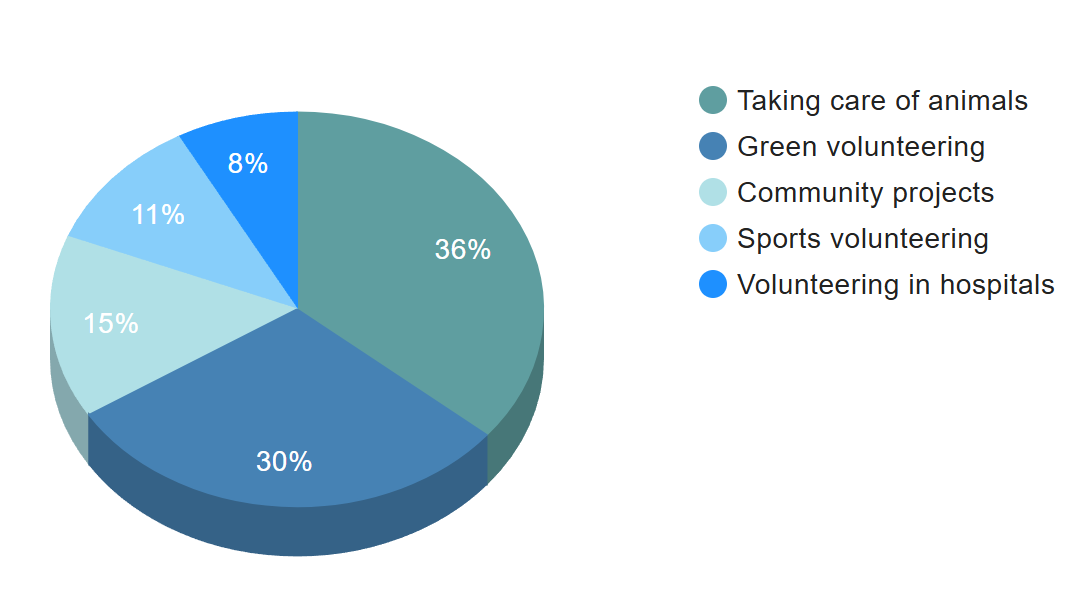
Write 200–250 words.
Use the following plan:
– make an opening statement on the subject of the project;
– select and report 2–3 facts;
– make 1–2 comparisons where relevant and give your comments;
– outline a problem that one can face with volunteer work and suggest a way of solving it;
– conclude by giving and explaining your opinion on the role of volunteering in our life.
Imagine that you are preparing a project with your friend. You have found some interesting material for the presentation and you want to read this text to your friend. You have 1.5 minutes to read the text silently, then be ready to read it out aloud. You will not have more than 1.5 minutes to read it.
Culture shock is a feeling of disorientation that occurs when someone moves to an unfamiliar cultural environment. This common experience affects millions of travelers, students, and immigrants worldwide each year.
The process typically involves several stages. Initially, people experience excitement about the new culture. This "honeymoon phase" is followed by frustration and anxiety as differences become apparent. Simple tasks like shopping or using public transport can suddenly feel overwhelming.
Physical symptoms often include headaches, insomnia, and loss of appetite. Psychological effects may involve homesickness, irritability, and even depression. Many people withdraw socially during this adjustment period.
Fortunately, culture shock is temporary. Most individuals gradually adapt by learning local customs and building new relationships. Keeping an open mind, maintaining a sense of humor, and connecting with both locals and people from your home country can help overcome these challenges.
Understanding culture shock helps prepare travelers for these natural feelings, making cross-cultural experiences more rewarding in the long term.
Task 2. Study the advertisement.
Birthday parties for all ages!

You are considering celebrating your birthday party in this café and now you’d like to get more information. In 1.5 minutes you are to ask five direct questions to find out about the following:
1) location
2) types of food served
3) vegetarian dishes
4) dancing floor
You have 20 seconds to ask each question.
You are going to give an interview. You have to answer five questions. Give full answers to the questions (2-3 sentences).
Remember that you have 40 seconds to answer each question.
0:00 / 0:00
Imagine that you and your friend are doing a school project “Shopping”. You have found some photos to illustrate it but for technical reasons you cannot send them now. Leave a voice message to your friend explaining your choice of the photos and sharing some ideas about the project. In 2.5 minutes be ready to:
explain the choice of the illustrations for the project by briefly describing them and noting the differences;
mention the advantages (1–2) of the two ways of shopping;
mention the disadvantages (1–2) the two ways of shopping;
express your opinion on the subject of the project – which way you prefer to shop and why.
You will speak for not more than 3 minutes (12–15 sentences). You have to talk continuously.

Прочитайте текст и выполните задания 12–18. В каждом задании запишите в поле ответа цифру 1, 2, 3 или 4, соответствующую выбранному Вами варианту ответа.
Пример ответа: 1
An end to second-hand coffee
To the naked eye, this farm is just like any other. But it doesn’t take long to realise that the farm of Jesus Martin, though not huge, is anything but ordinary.
Martin grew up like many others in the Santa Ana Valley –– known as the Coffee Triangle of Colombia—on a coffee farm owned by his father and grandfather. “I am the youngest of six children and we all worked the farm,” Martin said. “My parents focused their energies on teaching us the agricultural trade, but also the love behind it.” Despite this great dedication to coffee and respect for his family business, he ended up pursuing a different career altogether: law and business management. It didn’t come easy to him as coffee was never far away.
During every visit to his family’s humble farm, the rich aromas of beans roasting and the smell of his mother’s carrot cake caused his heart to beat faster. Coffee was his life, and in 2004, after years practicing law, he found a way to combine his legal knowledge, business education and family’s lifeline into what he called “the coffee dream project”.
Despite growing some of the most coveted beans in the world, most Colombians have never even tasted the Colombian coffee that is renowned around the world. Instead, local people drink what they call “second-hand coffee”, which is made from berries that haven't fully ripened, have been over-roasted or even infected with insects and diseases. Like most businesses in struggling economies, the farmers only make profits on exports—so they save their best stuff for higher paying countries. “Farming coffee for a profit is very challenging,” Martin explained, tossing a few berries in his hand. “The coffee trade intermediaries, exporters, roasters and big multinational companies are the ones that benefit the most in the coffee-trade chain.” Martin’s dream project, however, was to turn this process around, bringing specialty coffee back to Colombia.
The project, however, was a total surprise for his family. “When I first informed them, they told me I was crazy, they said it was a wild goose chase.”
Even with his background in farming, starting the project from the ground up was difficult. Convincing his workers to focus on quality was his biggest concern; most only cared about quantity since their wage was dependent on how many beans they picked. Martin recalled many hours, days and weeks training local farmers to understand the process, from the colours of the raw berries to the smell and taste of the beans once they’d been dried and sorted.
Once the farmers understood the importance of quality, it was onto phase two: bring the roasting process in-house, instead of paying for the beans to be roasted elsewhere. Buying his own roaster—one of the only five in the entire country—was expensive, but the purchase offered a huge saving in roasting, packaging and exporting costs.
By 2008, his passion started to pay off; he opened his flagship store Café Jesus Martin in Salento. The shop and its team of trained baristas, Martin said, have done much to teach the locals about enjoying specialty coffee. The look on their face when they take their first sip is what keeps him motivated. “They are reacting so positively; they’re discovering something entirely different than what they’re used to consuming,” Martin said. “When they discover the difference in quality of their coffee, they start to care more about where and whom it’s coming from.”
16. How did Martin’s family react to the idea of his project?
1) They fully supported it.
2) They didn’t believe in its success.
3) They thought it would take too much time and effort.
4) They thought he didn’t have proper background for it.
Прочитайте текст и выполните задания 12–18. В каждом задании запишите в поле ответа цифру 1, 2, 3 или 4, соответствующую выбранному Вами варианту ответа.
Пример ответа: 1
An end to second-hand coffee
To the naked eye, this farm is just like any other. But it doesn’t take long to realise that the farm of Jesus Martin, though not huge, is anything but ordinary.
Martin grew up like many others in the Santa Ana Valley –– known as the Coffee Triangle of Colombia—on a coffee farm owned by his father and grandfather. “I am the youngest of six children and we all worked the farm,” Martin said. “My parents focused their energies on teaching us the agricultural trade, but also the love behind it.” Despite this great dedication to coffee and respect for his family business, he ended up pursuing a different career altogether: law and business management. It didn’t come easy to him as coffee was never far away.
During every visit to his family’s humble farm, the rich aromas of beans roasting and the smell of his mother’s carrot cake caused his heart to beat faster. Coffee was his life, and in 2004, after years practicing law, he found a way to combine his legal knowledge, business education and family’s lifeline into what he called “the coffee dream project”.
Despite growing some of the most coveted beans in the world, most Colombians have never even tasted the Colombian coffee that is renowned around the world. Instead, local people drink what they call “second-hand coffee”, which is made from berries that haven't fully ripened, have been over-roasted or even infected with insects and diseases. Like most businesses in struggling economies, the farmers only make profits on exports—so they save their best stuff for higher paying countries. “Farming coffee for a profit is very challenging,” Martin explained, tossing a few berries in his hand. “The coffee trade intermediaries, exporters, roasters and big multinational companies are the ones that benefit the most in the coffee-trade chain.” Martin’s dream project, however, was to turn this process around, bringing specialty coffee back to Colombia.
The project, however, was a total surprise for his family. “When I first informed them, they told me I was crazy, they said it was a wild goose chase.”
Even with his background in farming, starting the project from the ground up was difficult. Convincing his workers to focus on quality was his biggest concern; most only cared about quantity since their wage was dependent on how many beans they picked. Martin recalled many hours, days and weeks training local farmers to understand the process, from the colours of the raw berries to the smell and taste of the beans once they’d been dried and sorted.
Once the farmers understood the importance of quality, it was onto phase two: bring the roasting process in-house, instead of paying for the beans to be roasted elsewhere. Buying his own roaster—one of the only five in the entire country—was expensive, but the purchase offered a huge saving in roasting, packaging and exporting costs.
By 2008, his passion started to pay off; he opened his flagship store Café Jesus Martin in Salento. The shop and its team of trained baristas, Martin said, have done much to teach the locals about enjoying specialty coffee. The look on their face when they take their first sip is what keeps him motivated. “They are reacting so positively; they’re discovering something entirely different than what they’re used to consuming,” Martin said. “When they discover the difference in quality of their coffee, they start to care more about where and whom it’s coming from.”
17. The most difficult thing for Martin in the beginning was to make his workers …
1) care about the product standards.
2) pick bigger quantities of beans.
3) undergo special training.
4) agree to lower wages.
Прочитайте текст и выполните задания 12–18. В каждом задании запишите в поле ответа цифру 1, 2, 3 или 4, соответствующую выбранному Вами варианту ответа.
Пример ответа: 1
An end to second-hand coffee
To the naked eye, this farm is just like any other. But it doesn’t take long to realise that the farm of Jesus Martin, though not huge, is anything but ordinary.
Martin grew up like many others in the Santa Ana Valley –– known as the Coffee Triangle of Colombia—on a coffee farm owned by his father and grandfather. “I am the youngest of six children and we all worked the farm,” Martin said. “My parents focused their energies on teaching us the agricultural trade, but also the love behind it.” Despite this great dedication to coffee and respect for his family business, he ended up pursuing a different career altogether: law and business management. It didn’t come easy to him as coffee was never far away.
During every visit to his family’s humble farm, the rich aromas of beans roasting and the smell of his mother’s carrot cake caused his heart to beat faster. Coffee was his life, and in 2004, after years practicing law, he found a way to combine his legal knowledge, business education and family’s lifeline into what he called “the coffee dream project”.
Despite growing some of the most coveted beans in the world, most Colombians have never even tasted the Colombian coffee that is renowned around the world. Instead, local people drink what they call “second-hand coffee”, which is made from berries that haven't fully ripened, have been over-roasted or even infected with insects and diseases. Like most businesses in struggling economies, the farmers only make profits on exports—so they save their best stuff for higher paying countries. “Farming coffee for a profit is very challenging,” Martin explained, tossing a few berries in his hand. “The coffee trade intermediaries, exporters, roasters and big multinational companies are the ones that benefit the most in the coffee-trade chain.” Martin’s dream project, however, was to turn this process around, bringing specialty coffee back to Colombia.
The project, however, was a total surprise for his family. “When I first informed them, they told me I was crazy, they said it was a wild goose chase.”
Even with his background in farming, starting the project from the ground up was difficult. Convincing his workers to focus on quality was his biggest concern; most only cared about quantity since their wage was dependent on how many beans they picked. Martin recalled many hours, days and weeks training local farmers to understand the process, from the colours of the raw berries to the smell and taste of the beans once they’d been dried and sorted.
Once the farmers understood the importance of quality, it was onto phase two: bring the roasting process in-house, instead of paying for the beans to be roasted elsewhere. Buying his own roaster—one of the only five in the entire country—was expensive, but the purchase offered a huge saving in roasting, packaging and exporting costs.
By 2008, his passion started to pay off; he opened his flagship store Café Jesus Martin in Salento. The shop and its team of trained baristas, Martin said, have done much to teach the locals about enjoying specialty coffee. The look on their face when they take their first sip is what keeps him motivated. “They are reacting so positively; they’re discovering something entirely different than what they’re used to consuming,” Martin said. “When they discover the difference in quality of their coffee, they start to care more about where and whom it’s coming from.”
18. We may conclude from the last paragraph that Martin’s store …
1) is what Martin’s project was all about.
2) serves coffee that is very different from what the Columbians were used too.
3) is only the first in the line of many more.
4) is the thing he cares about most now.
Прочитайте приведённый ниже текст / приведённые ниже тексты. Преобразуйте, если необходимо, слова, напечатанные заглавными буквами в конце строк, обозначенных номерами 19–24, так, чтобы они грамматически соответствовали содержанию текстов. Заполните пропуски полученными словами. Каждый пропуск соответствует отдельному заданию из группы 19–24.
Пример ответа: was built
Listening to the radio
Many of us get our news and entertainment from television and the Internet. You might be surprised to learn, then, that people who listen to the radio are much happier than (19)________ (THAT) people who use the other media outlets.
It makes perfect sense when you think about it. Television and the Internet offer entertainment, but negative activity (20)_________ (INCLUDE) in the mix as well. We sometimes see saddening news reports, and we do tedious things online, such as check account balances.
With radio, people listen to it because they want to feel good. It seems that in recent years we (21)__________ (FORGET) about the joy radio gives us because we focus on television and the Internet so much.
Funny noise
Maria was lying on her bed reading quietly. All of a sudden, she heard the strangest noise, which sounded something like insects, (22)___________ (COME) from the living room. Initially, she tried to ignore it but it just became more and more annoying. So, finally she (23)__________ (GO) to investigate. There in the living room, on the coffee table, was her laptop. On the screen, a pop-up advert (24)_________ (APPEAR), probably half an hour earlier, for a game with thousands of crickets. With one quick click, there was peace and quiet in the house again.
Прочитайте приведённый ниже текст / приведённые ниже тексты. Преобразуйте, если необходимо, слова, напечатанные заглавными буквами в конце строк, обозначенных номерами 19–24, так, чтобы они грамматически соответствовали содержанию текстов. Заполните пропуски полученными словами. Каждый пропуск соответствует отдельному заданию из группы 19–24.
Пример ответа: was built
Listening to the radio
Many of us get our news and entertainment from television and the Internet. You might be surprised to learn, then, that people who listen to the radio are much happier than (19)________ (THAT) people who use the other media outlets.
It makes perfect sense when you think about it. Television and the Internet offer entertainment, but negative activity (20)_________ (INCLUDE) in the mix as well. We sometimes see saddening news reports, and we do tedious things online, such as check account balances.
With radio, people listen to it because they want to feel good. It seems that in recent years we (21)__________ (FORGET) about the joy radio gives us because we focus on television and the Internet so much.
Funny noise
Maria was lying on her bed reading quietly. All of a sudden, she heard the strangest noise, which sounded something like insects, (22)___________ (COME) from the living room. Initially, she tried to ignore it but it just became more and more annoying. So, finally she (23)__________ (GO) to investigate. There in the living room, on the coffee table, was her laptop. On the screen, a pop-up advert (24)_________ (APPEAR), probably half an hour earlier, for a game with thousands of crickets. With one quick click, there was peace and quiet in the house again.
Прочитайте приведённый ниже текст / приведённые ниже тексты. Преобразуйте, если необходимо, слова, напечатанные заглавными буквами в конце строк, обозначенных номерами 19–24, так, чтобы они грамматически соответствовали содержанию текстов. Заполните пропуски полученными словами. Каждый пропуск соответствует отдельному заданию из группы 19–24.
Пример ответа: was built
Listening to the radio
Many of us get our news and entertainment from television and the Internet. You might be surprised to learn, then, that people who listen to the radio are much happier than (19)________ (THAT) people who use the other media outlets.
It makes perfect sense when you think about it. Television and the Internet offer entertainment, but negative activity (20)_________ (INCLUDE) in the mix as well. We sometimes see saddening news reports, and we do tedious things online, such as check account balances.
With radio, people listen to it because they want to feel good. It seems that in recent years we (21)__________ (FORGET) about the joy radio gives us because we focus on television and the Internet so much.
Funny noise
Maria was lying on her bed reading quietly. All of a sudden, she heard the strangest noise, which sounded something like insects, (22)___________ (COME) from the living room. Initially, she tried to ignore it but it just became more and more annoying. So, finally she (23)__________ (GO) to investigate. There in the living room, on the coffee table, was her laptop. On the screen, a pop-up advert (24)_________ (APPEAR), probably half an hour earlier, for a game with thousands of crickets. With one quick click, there was peace and quiet in the house again.
Прочитайте приведённый ниже текст / приведённые ниже тексты. Преобразуйте, если необходимо, слова, напечатанные заглавными буквами в конце строк, обозначенных номерами 19–24, так, чтобы они грамматически соответствовали содержанию текстов. Заполните пропуски полученными словами. Каждый пропуск соответствует отдельному заданию из группы 19–24.
Пример ответа: was built
Listening to the radio
Many of us get our news and entertainment from television and the Internet. You might be surprised to learn, then, that people who listen to the radio are much happier than (19)________ (THAT) people who use the other media outlets.
It makes perfect sense when you think about it. Television and the Internet offer entertainment, but negative activity (20)_________ (INCLUDE) in the mix as well. We sometimes see saddening news reports, and we do tedious things online, such as check account balances.
With radio, people listen to it because they want to feel good. It seems that in recent years we (21)__________ (FORGET) about the joy radio gives us because we focus on television and the Internet so much.
Funny noise
Maria was lying on her bed reading quietly. All of a sudden, she heard the strangest noise, which sounded something like insects, (22)___________ (COME) from the living room. Initially, she tried to ignore it but it just became more and more annoying. So, finally she (23)__________ (GO) to investigate. There in the living room, on the coffee table, was her laptop. On the screen, a pop-up advert (24)_________ (APPEAR), probably half an hour earlier, for a game with thousands of crickets. With one quick click, there was peace and quiet in the house again.
Прочитайте приведённый ниже текст / приведённые ниже тексты. Преобразуйте, если необходимо, слова, напечатанные заглавными буквами в конце строк, обозначенных номерами 19–24, так, чтобы они грамматически соответствовали содержанию текстов. Заполните пропуски полученными словами. Каждый пропуск соответствует отдельному заданию из группы 19–24.
Пример ответа: was built
Listening to the radio
Many of us get our news and entertainment from television and the Internet. You might be surprised to learn, then, that people who listen to the radio are much happier than (19)________ (THAT) people who use the other media outlets.
It makes perfect sense when you think about it. Television and the Internet offer entertainment, but negative activity (20)_________ (INCLUDE) in the mix as well. We sometimes see saddening news reports, and we do tedious things online, such as check account balances.
With radio, people listen to it because they want to feel good. It seems that in recent years we (21)__________ (FORGET) about the joy radio gives us because we focus on television and the Internet so much.
Funny noise
Maria was lying on her bed reading quietly. All of a sudden, she heard the strangest noise, which sounded something like insects, (22)___________ (COME) from the living room. Initially, she tried to ignore it but it just became more and more annoying. So, finally she (23)__________ (GO) to investigate. There in the living room, on the coffee table, was her laptop. On the screen, a pop-up advert (24)_________ (APPEAR), probably half an hour earlier, for a game with thousands of crickets. With one quick click, there was peace and quiet in the house again.
Прочитайте приведённый ниже текст / приведённые ниже тексты. Преобразуйте, если необходимо, слова, напечатанные заглавными буквами в конце строк, обозначенных номерами 19–24, так, чтобы они грамматически соответствовали содержанию текстов. Заполните пропуски полученными словами. Каждый пропуск соответствует отдельному заданию из группы 19–24.
Пример ответа: was built
Listening to the radio
Many of us get our news and entertainment from television and the Internet. You might be surprised to learn, then, that people who listen to the radio are much happier than (19)________ (THAT) people who use the other media outlets.
It makes perfect sense when you think about it. Television and the Internet offer entertainment, but negative activity (20)_________ (INCLUDE) in the mix as well. We sometimes see saddening news reports, and we do tedious things online, such as check account balances.
With radio, people listen to it because they want to feel good. It seems that in recent years we (21)__________ (FORGET) about the joy radio gives us because we focus on television and the Internet so much.
Funny noise
Maria was lying on her bed reading quietly. All of a sudden, she heard the strangest noise, which sounded something like insects, (22)___________ (COME) from the living room. Initially, she tried to ignore it but it just became more and more annoying. So, finally she (23)__________ (GO) to investigate. There in the living room, on the coffee table, was her laptop. On the screen, a pop-up advert (24)_________ (APPEAR), probably half an hour earlier, for a game with thousands of crickets. With one quick click, there was peace and quiet in the house again.
Прочитайте приведённый ниже текст. Образуйте от слов, напечатанных заглавными буквами в конце строк, обозначенных номерами 25–29, однокоренные слова, так, чтобы они грамматически и лексически соответствовали содержанию текста. Заполните пропуски полученными словами. Каждый пропуск соответствует отдельному заданию из группы 25–29.
Пример ответа: foundation
Niagara Falls Journal
July 24 - My family and I got an early morning start on our driving vacation from Illinois to Niagara Falls in Ontario, Canada.
I love reading the street signs and food labels in French and English. How (25) __________________(USUAL) to be in a country that is bilingual!
July 25 - We started our day at Horseshoe Falls. Just watching all the millions of gallons of water flow over the Falls is mesmerizing. I couldn't take my eyes off the (26) __________________(NATURE) beauty. It was also very loud.
July 26 - Today we went on the Maid of the Mist boat ride. We had to put on very heavy raincoats. We needed this (27) ________________(PROTECT) because our boat took us past the American Falls and into the heavy mist of Horseshoe Falls. I took some great pictures.
We came back to the Falls at night to see the light display. Hundreds of lights that (28) __________________(CONSTANT) changed their colour were directed on the Falls.
July 27 - We left Niagara Falls for the remainder of our trip to Toronto, Canada. We drove along Queen Victoria Park which parallels the Niagara River and was full of (29)__________________(TOUR). I agree with Winston Churchill who once remarked that this route is "the prettiest Sunday afternoon drive in the world."
Прочитайте приведённый ниже текст. Образуйте от слов, напечатанных заглавными буквами в конце строк, обозначенных номерами 25–29, однокоренные слова, так, чтобы они грамматически и лексически соответствовали содержанию текста. Заполните пропуски полученными словами. Каждый пропуск соответствует отдельному заданию из группы 25–29.
Пример ответа: foundation
Niagara Falls Journal
July 24 - My family and I got an early morning start on our driving vacation from Illinois to Niagara Falls in Ontario, Canada.
I love reading the street signs and food labels in French and English. How (25) __________________(USUAL) to be in a country that is bilingual!
July 25 - We started our day at Horseshoe Falls. Just watching all the millions of gallons of water flow over the Falls is mesmerizing. I couldn't take my eyes off the (26) __________________(NATURE) beauty. It was also very loud.
July 26 - Today we went on the Maid of the Mist boat ride. We had to put on very heavy raincoats. We needed this (27) ________________(PROTECT) because our boat took us past the American Falls and into the heavy mist of Horseshoe Falls. I took some great pictures.
We came back to the Falls at night to see the light display. Hundreds of lights that (28) __________________(CONSTANT) changed their colour were directed on the Falls.
July 27 - We left Niagara Falls for the remainder of our trip to Toronto, Canada. We drove along Queen Victoria Park which parallels the Niagara River and was full of (29)__________________(TOUR). I agree with Winston Churchill who once remarked that this route is "the prettiest Sunday afternoon drive in the world.
Прочитайте приведённый ниже текст. Образуйте от слов, напечатанных заглавными буквами в конце строк, обозначенных номерами 25–29, однокоренные слова, так, чтобы они грамматически и лексически соответствовали содержанию текста. Заполните пропуски полученными словами. Каждый пропуск соответствует отдельному заданию из группы 25–29.
Пример ответа: foundation
Niagara Falls Journal
July 24 - My family and I got an early morning start on our driving vacation from Illinois to Niagara Falls in Ontario, Canada.
I love reading the street signs and food labels in French and English. How (25) __________________(USUAL) to be in a country that is bilingual!
July 25 - We started our day at Horseshoe Falls. Just watching all the millions of gallons of water flow over the Falls is mesmerizing. I couldn't take my eyes off the (26) __________________(NATURE) beauty. It was also very loud.
July 26 - Today we went on the Maid of the Mist boat ride. We had to put on very heavy raincoats. We needed this (27) ________________(PROTECT) because our boat took us past the American Falls and into the heavy mist of Horseshoe Falls. I took some great pictures.
We came back to the Falls at night to see the light display. Hundreds of lights that (28) __________________(CONSTANT) changed their colour were directed on the Falls.
July 27 - We left Niagara Falls for the remainder of our trip to Toronto, Canada. We drove along Queen Victoria Park which parallels the Niagara River and was full of (29)__________________(TOUR). I agree with Winston Churchill who once remarked that this route is "the prettiest Sunday afternoon drive in the world.
Прочитайте приведённый ниже текст. Образуйте от слов, напечатанных заглавными буквами в конце строк, обозначенных номерами 25–29, однокоренные слова, так, чтобы они грамматически и лексически соответствовали содержанию текста. Заполните пропуски полученными словами. Каждый пропуск соответствует отдельному заданию из группы 25–29.
Пример ответа: foundation
Niagara Falls Journal
July 24 - My family and I got an early morning start on our driving vacation from Illinois to Niagara Falls in Ontario, Canada.
I love reading the street signs and food labels in French and English. How (25) __________________(USUAL) to be in a country that is bilingual!
July 25 - We started our day at Horseshoe Falls. Just watching all the millions of gallons of water flow over the Falls is mesmerizing. I couldn't take my eyes off the (26) __________________(NATURE) beauty. It was also very loud.
July 26 - Today we went on the Maid of the Mist boat ride. We had to put on very heavy raincoats. We needed this (27) ________________(PROTECT) because our boat took us past the American Falls and into the heavy mist of Horseshoe Falls. I took some great pictures.
We came back to the Falls at night to see the light display. Hundreds of lights that (28) __________________(CONSTANT) changed their colour were directed on the Falls.
July 27 - We left Niagara Falls for the remainder of our trip to Toronto, Canada. We drove along Queen Victoria Park which parallels the Niagara River and was full of (29)__________________(TOUR). I agree with Winston Churchill who once remarked that this route is "the prettiest Sunday afternoon drive in the world.
Прочитайте приведённый ниже текст. Образуйте от слов, напечатанных заглавными буквами в конце строк, обозначенных номерами 25–29, однокоренные слова, так, чтобы они грамматически и лексически соответствовали содержанию текста. Заполните пропуски полученными словами. Каждый пропуск соответствует отдельному заданию из группы 25–29.
Пример ответа: foundation
Niagara Falls Journal
July 24 - My family and I got an early morning start on our driving vacation from Illinois to Niagara Falls in Ontario, Canada.
I love reading the street signs and food labels in French and English. How (25) __________________(USUAL) to be in a country that is bilingual!
July 25 - We started our day at Horseshoe Falls. Just watching all the millions of gallons of water flow over the Falls is mesmerizing. I couldn't take my eyes off the (26) __________________(NATURE) beauty. It was also very loud.
July 26 - Today we went on the Maid of the Mist boat ride. We had to put on very heavy raincoats. We needed this (27) ________________(PROTECT) because our boat took us past the American Falls and into the heavy mist of Horseshoe Falls. I took some great pictures.
We came back to the Falls at night to see the light display. Hundreds of lights that (28) __________________(CONSTANT) changed their colour were directed on the Falls.
July 27 - We left Niagara Falls for the remainder of our trip to Toronto, Canada. We drove along Queen Victoria Park which parallels the Niagara River and was full of (29)__________________(TOUR). I agree with Winston Churchill who once remarked that this route is "the prettiest Sunday afternoon drive in the world.
Прочитайте текст с пропусками, обозначенными номерами 30–36. Эти номера соответствуют заданиям 30–36, в которых представлены возможные варианты ответов. Запишите в поле ответа цифру 1, 2, 3 или 4, соответствующую выбранному Вами варианту ответа.
Пример ответа: 1
A sign of weakness?
What should you do when you realise that you have to apologise? Is it better to swallow your pride and say you’re sorry when somebody is waiting 30 ______ your apology? The psychologist Jack Black says that people worry that an apology will be 31 ______ as a sign of weakness, rather than as their effort to understand and make up with the opponent. But he adds that effective apologies address the person’s feelings — they don’t prove a point. As for how to do it, Professor Black has the following advice, “The right way to apologise is the way your mother taught you. Say you threw a stone at your brother. She’d have you go and 32 ______ him in the eye and say: ‘I’m sorry I threw the stone at you and I won’t do it again.’ It’s important to name what you did wrong, to show yourself as being regretful in some way and to indicate what might be different in the future.”
You should 33 ______ that the number of times you’ll need to repeat the apology may vary depending on where you live. 34 ______ to preliminary data collected by Professor Black, for a minor offence, the optimal number is a single “I’m sorry”. “If the offence is large, then making two apologies seems to be the magic number for restoring trust and liking,” Jack Black says. 35 ______, if you’re British, you may need to double that. “A single ‘Sorry’ does not 36 ______ as an apology: we have to say it so many times with a lot of adjectives,” says Professor Black.
1) out 2) up 3) for 4) to
Прочитайте текст с пропусками, обозначенными номерами 30–36. Эти номера соответствуют заданиям 30–36, в которых представлены возможные варианты ответов. Запишите в поле ответа цифру 1, 2, 3 или 4, соответствующую выбранному Вами варианту ответа.
Пример ответа: 1
A sign of weakness?
What should you do when you realise that you have to apologise? Is it better to swallow your pride and say you’re sorry when somebody is waiting 30 ______ your apology? The psychologist Jack Black says that people worry that an apology will be 31 ______ as a sign of weakness, rather than as their effort to understand and make up with the opponent. But he adds that effective apologies address the person’s feelings — they don’t prove a point. As for how to do it, Professor Black has the following advice, “The right way to apologise is the way your mother taught you. Say you threw a stone at your brother. She’d have you go and 32 ______ him in the eye and say: ‘I’m sorry I threw the stone at you and I won’t do it again.’ It’s important to name what you did wrong, to show yourself as being regretful in some way and to indicate what might be different in the future.”
You should 33 ______ that the number of times you’ll need to repeat the apology may vary depending on where you live. 34 ______ to preliminary data collected by Professor Black, for a minor offence, the optimal number is a single “I’m sorry”. “If the offence is large, then making two apologies seems to be the magic number for restoring trust and liking,” Jack Black says. 35 ______, if you’re British, you may need to double that. “A single ‘Sorry’ does not 36 ______ as an apology: we have to say it so many times with a lot of adjectives,” says Professor Black.
31. 1) treated 2) referred 3) connected 4) related
Прочитайте текст с пропусками, обозначенными номерами 30–36. Эти номера соответствуют заданиям 30–36, в которых представлены возможные варианты ответов. Запишите в поле ответа цифру 1, 2, 3 или 4, соответствующую выбранному Вами варианту ответа.
Пример ответа: 1
A sign of weakness?
What should you do when you realise that you have to apologise? Is it better to swallow your pride and say you’re sorry when somebody is waiting 30 ______ your apology? The psychologist Jack Black says that people worry that an apology will be 31 ______ as a sign of weakness, rather than as their effort to understand and make up with the opponent. But he adds that effective apologies address the person’s feelings — they don’t prove a point. As for how to do it, Professor Black has the following advice, “The right way to apologise is the way your mother taught you. Say you threw a stone at your brother. She’d have you go and 32 ______ him in the eye and say: ‘I’m sorry I threw the stone at you and I won’t do it again.’ It’s important to name what you did wrong, to show yourself as being regretful in some way and to indicate what might be different in the future.”
You should 33 ______ that the number of times you’ll need to repeat the apology may vary depending on where you live. 34 ______ to preliminary data collected by Professor Black, for a minor offence, the optimal number is a single “I’m sorry”. “If the offence is large, then making two apologies seems to be the magic number for restoring trust and liking,” Jack Black says. 35 ______, if you’re British, you may need to double that. “A single ‘Sorry’ does not 36 ______ as an apology: we have to say it so many times with a lot of adjectives,” says Professor Black.
32. 1) watch 2) glance 3) see 4) look
Когда будет экзамен
ИЮНЬ 2027
Дата сдачи 2027
15 ИЮНЯ
Резервные даты 2027
24 И 25 ИЮНЯ
Экзамен длится
3 Ч 10 МИН
Изучай средние баллы и оценивай свои шансы
Занимайся без стресса и паники и приходи к топовым результатам

В школе дают теорию, в Банке — вся нужная практика для экзамена
Готовься к экзаменам системно, а не «как получится»

Получай подсказки, если задача слишком сложная

Тренируйся по 10–15 минут каждый день

Отрабатывай западающие задания и темы

Тогда начинай тренироваться сегодня —
практика приведёт к высоким баллам